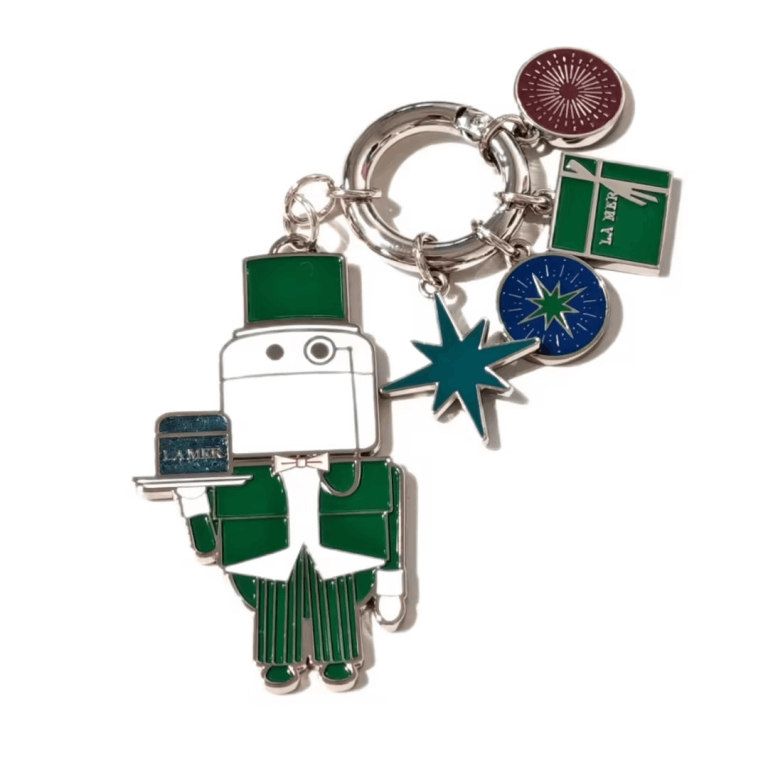
Executive Summary: Top Jewelry recently partnered with La Mer, the luxury skincare icon under the Estée Lauder Group, to design and manufacture a series of custom metal keychains for their high-end Gift-With-Purchase (GWP) initiatives.This case study details our end-to-end process—from developing 15 initial design concepts to delivering 56,425 finished units within a 30-day window. We focus on material engineering, international regulatory compliance, and the high-speed production cycles required by Tier-1 beauty brands.
Project Background and Core Objectives
As a premier luxury brand, La Mer maintains rigorous standards for its promotional accessories. For this GWP project, the client established three critical KPIs:
· Brand Distinction: The design needed to be a clear departure from “off-the-shelf” market products, ensuring consumers immediately associate the accessory with the La Mer brand identity.
· Regulatory Compliance: All materials were required to pass REACH certification, specifically ensuring they were nickel-free and lead-free.
· Scalability & Cost-Efficiency: We needed to maintain a premium “heavy” feel while keeping the unit price within budget for a mass production run of over 50,000 units.
Experience Sharing:
When manufacturing for Tier-1 brands like L’Oréal or Dior, a custom metal keychain is never just a ‘giveaway.’ It is a test of supply chain transparency. Our experience taught us that for luxury icons like La Mer, the real product is risk management—ensuring that every unit, from the first design to the final shipment, meets strict international safety standards.
https://www.top-jewelry.net/loreal-necklace/
Design & Development Process
Working from the brand’s visual guidelines, we began product development:
• Concept Generation: We submitted 15 unique design iterations tailored to the brand’s aesthetic.
• Prototyping Cycle: The client selected 3 designs for physical sampling, which we delivered within a 7-10 day window.
• Iterative Refinement: Over 4 rounds of adjustments focusing on proportions and color precision, the final production version was approved.
Production Challenges: Achieving Color Fidelity
During the four-round iterative development of this custom metal keychain, our primary technical hurdle was replicating La Mer’s signature green during the color-filling (enamel) stage. The chemical properties of the pigment made it difficult to maintain consistent adhesion and color vibrancy on a metal surface. In fact, the initial prototypes showed a subtle color shift once the enamel was fully cured. Fixing a color shift of ΔE=2.1 required more than a simple pigment adjustment. We applied interface engineering to solve the root cause: the bond between the plating and the substrate. By re-engineering the surface tension of the electroplated layer, we ensured the ‘La Mer Green’ remained stable after the enamel fully cured.
Technical Breakthrough: Interface Engineering for : ΔE<1.0
When faced with a color deviation of ΔE=2.1 in early samples, we moved beyond simple pigment adjustments. Instead, we applied interface engineering to optimize the bond between the plating and the substrate, solving the color shift at its root:
1. Enhanced Pre-treatment: We increased the electrolytic degreasing current density from 3A/dm² to 4.5A/dm² and extended the processing time to 50 seconds, ensuring residual oil levels dropped below 0.1mg/m² . Additionally, an acid activation process using a 10% sulfuric and 2% hydrofluoric acid blend created a micro-etched surface ( 0.2-0.5μm depth) to maximize mechanical interlocking.
2. Optimized Pre-plating: By increasing the cyanide copper pre-plating thickness from 37μm to 45μm , we utilized lattice matching between the copper and the zinc alloy substrate. This improved bonding strength from 5-7N/mm² to ≥12N/mm² (per GB/T 5270 standards). We also introduced an ultrasonic deionized water rinse ( 50kHz, for 3 minutes) to prevent chemical contamination.
3. Quantifiable Results: Bonding Validation: The units passed a 48 -hour salt spray test and a cross-cut adhesion test (5B rating) with zero peeling or blistering • Color Precision: The contact angle of the metal surface was reduced from 78° (hydrophobic) to 52° (hydrophilic)—a 33% improvement in wetting—allowing the enamel to spread uniformly. Consequently, the ΔE for mass production remained stable between 0.6 and 0.9 , surpassing the standard luxury requirement of ΔE < 1.5.
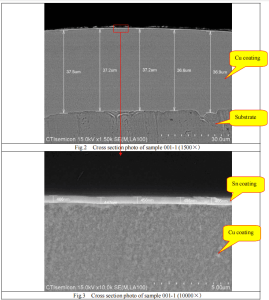
Table 1 – Common Plating Thicknesses Available on the Market
Color Formulation Strategy for La Mer Green
The signature La Mer aesthetic is defined by its sophisticated Teal-Green hue, specifically positioned at approximately 167° on the color wheel. This specific shade is characterized by its cool, low-luminosity, and medium-to-high saturation, which evokes a sense of deep-sea luxury and professional prestige.
When developing the color-filling formula for the custom metal keychain, we focus on three technical pillars:
•Pigment Selection: Phthalo Green serves as our core pigment, providing the most accurate foundation for La Mer’s cool-toned deep green. We introduce a precise volume of Iron Oxide Yellow to add a hint of warmth—preventing the color from appearing too blue—and utilize Carbon Black to control the final luminosity of the mixture.
•Benchmarking: We use Pantone 7726 C and 7727 C as our primary comparison standards, as these are the closest professional matches to the brand’s identity.
• Substrate Testing: To ensure accuracy, color matching is performed on the actual metal material rather than paper. This is critical because the pigment darkens significantly as it cures; final comparisons are only made once the sample is 100% dry.
Technical Formulation (Per Liter of White Base Pigment):
• Phthalo Green Pigment: ~45–55ml
• Iron Oxide Yellow Pigment: ~5–8ml
• Carbon Black Pigment: ~12–18ml
Mixing Protocol:
The process begins by establishing the primary hue with Phthalo Green, followed by a controlled introduction of Iron Oxide Yellow to calibrate the warmth. Carbon Black is added last to achieve the exact target depth. We add pigments in small increments with high-shear agitation to ensure complete dispersion. Because the enamel typically darkens by 5%–10% during the drying phase, we intentionally formulate the wet mixture to be slightly lighter than the target swatch to achieve a perfect final match.
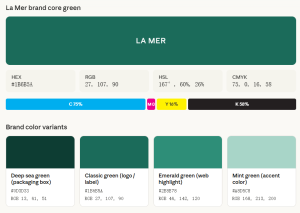
Table 2 – Color Mixing Formula Diagram
Material Selection & Technical Specifications
To balance luxury aesthetics with durability and cost, we implemented an industrial-grade solution for the custom metal keychain:
•Primary Material: Main material: Zinc alloy is selected. The reason is that it has a low melting point and good fluidity, which enables high-precision dimensional control of ±0.02 mm for the 2.5*5.5 cm specification, and it is easy to undergo complex surface treatments.
| dimension | Zinc Alloy | Stainless Steel | Copper | Tin Alloy |
| Mold precision | Extremely high, suitable for complex 3D modeling | Lower, typically used for flat stamping | High, but the materials are extremely expensive | It is relatively high, but the intensity is insufficient |
| Surface treatment | Excellent, with strong electroplating adhesion | Limited, mainly in natural color or PVD | Good, but highly prone to oxidation | General |
| Production cost | Economical, suitable for mass production | Higher, with expensive processing fees | Extremely high, not suitable for promotional items | Medium |
| Tactile quality | Steady and endowed with a high-end metallic texture | Lightweight (unless thickened) | Heavy and upscale | soft |
Table 3 – Material Comparison Chart
•The process involves electroplating with copper first, followed by a rhodium-like color plating. The main materials used are CU and SN. The total plating thickness is strictly controlled to be greater than 45um. This parameter ensures that the product does not easily fade or oxidize during daily use with friction.Please refer to the ‘Technical Breakthrough’ section above for the relevant test reports and data.
•Surface treatment: A combination of color-filling and enamel techniques was utilized to guarantee high color saturation and razor-sharp edges.
Professional Insight: The Critical Role of Plating Depth
For a custom metal keychain, the difference between ‘premium’ and ‘cheap’ is often invisible at first glance: it’s the plating depth. While market-standard items use less than 30μm, which leads to fading in 90 days, we maintain a 45μm standard. This extra 15μm is what keeps the accessory oxidation-free after a year of daily use.
Quality Control Standards
Beyond achieving basic brand aesthetics, we implemented a rigorous suite of testing protocols for this custom metal keychain project to ensure international export compliance and adhere to La Mer’s internal quality benchmarks. Environmental & Safety Compliance: All raw materials are fully REACH-compliant, supported by third-party laboratory verification for Nickel and Lead content. Nickel Release: We adhere to EN1811 and EN12472 standards, maintaining release levels below <0.5ug/cm2/week for non-piercing jewelry. Lead Content: Products meet both REACH and CPSIA-Pb requirements, with lead concentrations strictly under100 ppm.
https://echa.europa.eu/candidate-list-table
•Stability & Corrosion Resistance: To simulate high-humidity environments and long-term wear, we subjected the electroplated layers to an intensive 48-hour salt spray test. Our custom metal keychains achieved a “Grade 10” rating Test standards:
ISO 7253-2002 or ASTM B368-09 or ISO 9227-2006 Total-10 grade, according to the surface corrosion degreethe lowest level:1 grade, the highest level:10 grade,passing line:level 6
ISO 9227:2022 – Corrosion tests in artificial atmospheres — Salt spray tests
•100% Manual Inspection Protocol: We perform a complete manual audit of all enamel-filled sections to eliminate any visible defects. Our inspection team enforces a strict 3-tier defect classification.
Enamel Overflow: Any color bleeding or overflow at the pattern edges exceeding 0.2mm is categorized as a failure.
• Surface Bubbles: A unit is rejected if it contains a single bubble with a diameter ≥0.3mm or any visible cluster of micro-pinholes
• Foreign Impurities: Any off-color specks or debris ≥0.2mm within the brand-color area results in immediate rejection.
Every finished piece must pass through a dual-verification gate—a 3-second rapid initial scan followed by a 5-second high-magnification review—to ensure that the final custom metal keychain delivered to the consumer meets the luxury-grade standards of the La Mer brand.
Finished Product Display
A metal pendant themed after La Mer and Ralph Lauren, featuring a cartoon character in a green and white uniform as the main design, paired with star-shaped and compass-shaped accessories, exuding a refined and vintage charm.
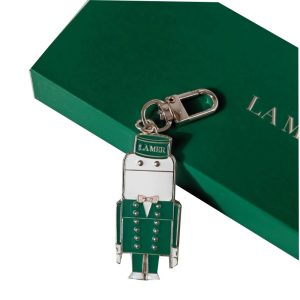
LA MER Classic Doorman Design Metal Keychain, featuring a green and white uniform with a pink bow tie, exquisite enamel craftsmanship, and dual functionality as both a bag accessory and collectible item.
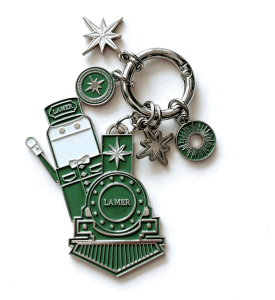
LA MER Limited Edition Train Conductor Figurine Metal Keychain. Featuring a green and white enamel finish, it is adorned with star-shaped and round pendant accessories. This exquisite and retro design offers both practical bag-hanging functionality and collectible value.
Project Outcomes and Delivery
• Total Volume: We successfully delivered a total of 56,425 finished units for this global campaign.
• Production Lead Time: The entire process—from final sample approval to bulk warehouse entry—was completed in just 30 days.
• Durability Performance: By utilizing a strictly controlled 45um electroplating thickness, the product successfully passed an intensive 48-hour salt spray test. This technical standard ensures that the custom metal keychain remains free from oxidation or plating peel throughout the terminal distribution process, even in extreme storage conditions.
•What certifications are required for products entering the European market?
All products exported to Europe must be fully compliant with REACH regulations. For metal accessories and custom metal keychains, this specifically involves passing tests for Nickel release (EN1811 and EN12472) and Lead content (CPSIA or REACH Pb restrictions) to ensure complete consumer safety.
Planning Your Next Brand Marketing Campaign?
Top Jewelry provides a fully integrated service model—encompassing bespoke design, precision tooling, large-scale manufacturing, and rigorous compliance testing. We invite you to contact us today for a complimentary design proposal and a detailed quotation tailored specifically to your brand’s aesthetic and market requirements.
Contact us:https://www.top-jewelry.net/contact-us/
What are the exact dimensions of this custom metal keychain?
The standard dimensions for the La Mer project were 2.5*5.5cm. However, we provide full flexibility and can customize your keychains in any size ranging from 2cm to 8cm, depending on your specific design requirements and budget.
Can you provide eco-friendly material alternatives to zinc alloy?
Yes, we certainly can. Top Jewelry supports a wide range of sustainable and recycled material options, including stainless steel, tin alloy, copper, and silver, to help your brand meet its environmental goals.
Does your company have experience working with global luxury brands?
We have over 28 years of specialized experience in the promotional products industry. We are a long-term, trusted supplier for major international groups, including L’Oréal, LVMH, Dior, and Estée Lauder.
What is the Minimum Order Quantity (MOQ) for a custom metal keychain?
Typically, our MOQ for a custom metal keychain starts at units. For large-scale marketing campaigns exceeding units, we provide highly competitive tiered pricing structures to ensure the best value for your project.
How long does it take from design approval to final delivery?
The physical prototyping phase generally requires 7 to 10 days. Once the sample is approved, we can complete mass production and final logistics delivery within a 20 to 30 day window, depending on the order volume.
Editor:Felix