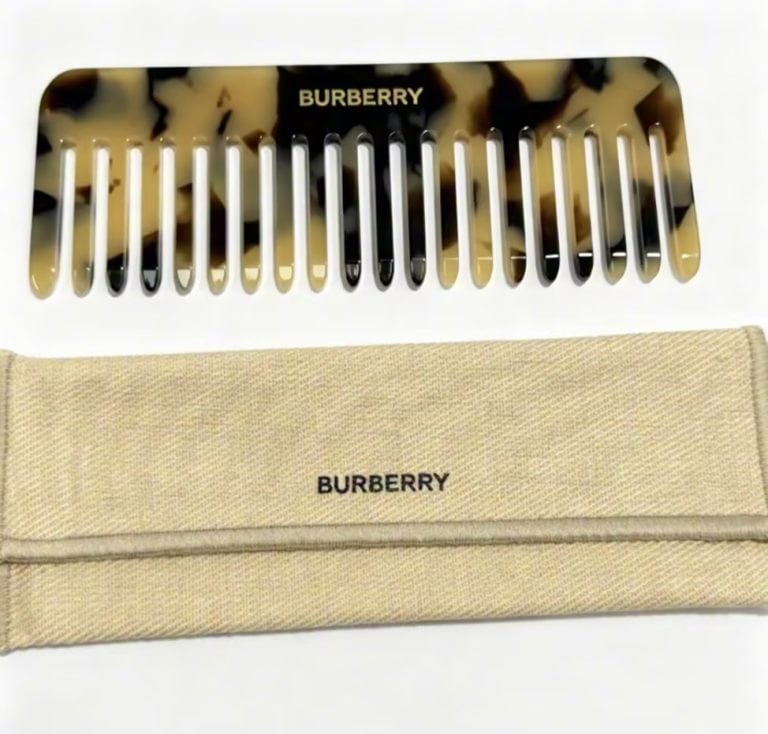
As a Sedex/SMETA-audited, BSCI-certified factory direct manufacturer producing custom promotional accessories for global fashion houses, we have run acetate comb programs from initial material selection through final AQL Level II inspection — and the details below come from that hands-on experience, not a product catalogue.
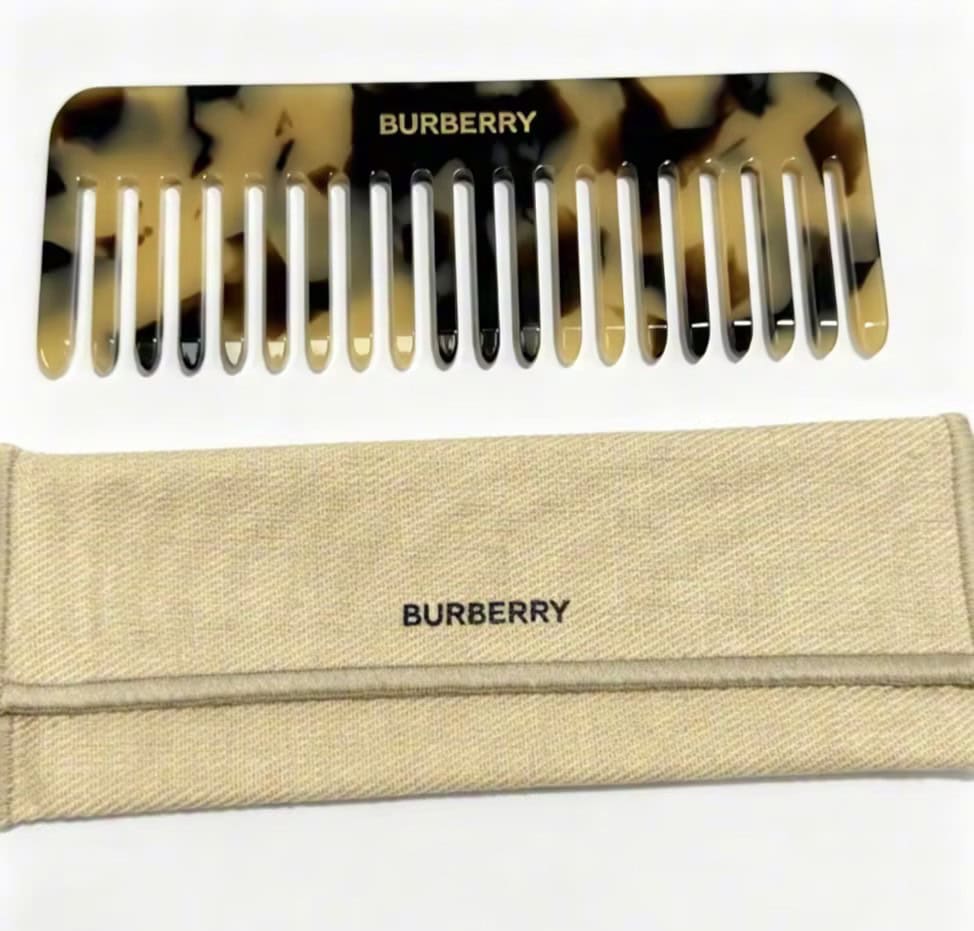
Quick Facts
- Material: Cellulose acetate sheet stock — density 1.28 g/cm³, heat deflection temperature 85°C
- Tooth-tip radius: ≥ 0.5 mm (CNC-cut + full hand polishing, rounded water-drop profile on every tooth)
- Logo process: Hot stamping at precisely 135°C / 0.45 MPa / 1.2 s dwell time
- Compliance: REACH SVHC 161-substance screening; CPSIA-aligned lead standard
- Quality control: AQL Level II sampling inspection + 100% full inspection before packing
- Lead time: 25–30 working days after artwork approval
- MOQ: 1,000 pieces
- Certifications: BSCI, Sedex/SMETA (2-Pillar & 4-Pillar), FSC
Why Promotional Gift Buyers Are Choosing Acetate for Hair Comb Bulk Orders
Walk into any department store beauty counter and you will notice that the combs sitting next to the £300 serums are not made of shiny injection plastic. They have a depth of colour, a warmth to the touch, and an almost jade-like translucence that no polypropylene blank will ever replicate. That material is cellulose acetate, and understanding why it behaves differently from ordinary plastic is the first thing any buyer needs to know before placing a hair comb bulk order destined for a luxury retail channel.
This article walks through material science, production process, real quality traps, compliance requirements, and packaging — everything a sourcing manager or promotional gift distributor needs to specify correctly the first time.
Acetate vs. Injection Plastic: What the Material Data Actually Says
Injection-moulded plastic combs are produced in a single shot: molten polymer is forced into a steel mould, cooled, and ejected. The process is fast and inexpensive. It also leaves visible parting-line seams, creates a high-gloss surface reflectance that reads as cheap, and — critically for hair tools — generates significant static charge during use. Static electricity is not a comfort issue; it physically lifts the cuticle scale, causing frizz and long-term strand damage.
Cellulose acetate is manufactured from wood pulp or cotton linters. The raw material is extruded into thick sheets, then cooled slowly over several days, allowing pigment and colour to flow organically through the mass. This is why every piece cut from a tortoiseshell-pattern acetate sheet carries a genuinely unique marbling — the pattern is not printed, not transferred, not repeated. The density of 1.28 g/cm³ gives the finished comb a satisfying hand weight that reinforces perceived quality the moment a customer picks it up. Its heat deflection temperature of 85°C means it will not warp in a hot car or a bathroom left in direct sun.
The anti-static property is intrinsic to the chemistry: acetate carries a surface charge dissipation characteristic that injection plastics simply do not. For wholesale hair comb programs aimed at beauty brands, this single feature regularly becomes a headline claim on the retail packaging.
If your client is a specialty retailer positioning combs as a “hair wellness” accessory rather than a commodity grooming tool, injection plastic is the wrong starting point — regardless of price. The acetate comb program we ran for a leading global luxury fashion brand demonstrates how far this material can be pushed when paired with the right processes.
The Production Process, Step by Step
Sheet Selection and Blanking
Not all acetate sheet is equal. We specify sheets with a minimum thickness tolerance of ±0.1 mm across the full panel before any blanking begins. Sheets with visible bubbles, colour streaks outside pattern spec, or density inconsistencies are rejected at incoming quality control (IQC). Passing material then goes to the CNC cutting table, where a CAD-optimised nesting layout is used to plan the cut paths.
Because acetate raw material costs more than injection-grade plastic, material yield directly affects unit economics. By optimising the cut layout using CAD nesting, we increased sheet utilisation from approximately 80% to 92% on a recent program — a meaningful reduction in per-unit material waste without any change to the comb geometry or blank dimensions.
CNC Tooth Cutting vs. Stamping: A Real Difference That Shows Up at the Scalp
This is where bulk comb production splits into two very different quality tiers. Low-cost combs — both plastic and acetate — are produced with punch-press stamping: a die punches the tooth gaps in one stroke. It is fast. It also leaves micro-burrs at the tooth tip that no amount of barrel tumbling will fully remove. Those burrs snag the hair cuticle and, in clinical terms, cause mechanical breakage.
Our process uses CNC precision tooth cutting (essentially a high-speed milling operation) followed by individual tooth-edge dressing on a belt sander, then full hand polishing (grinding and polishing each tooth surface by hand). The result is a tooth-tip radius of ≥ 0.5 mm — a rounded water-drop profile that meets the dental-tool standard for atraumatic contact. For a wholesale hair comb destined for a premium gift set, this distinction is the difference between a five-star review and a return claim.
Polishing
After tooth cutting, each comb body goes through a multi-stage polishing sequence: coarse belt sanding to remove tool marks, medium-grit wheel polishing to even the surface, and finally hand-buffing with cotton wheels and polishing compound. The finished surface has the characteristic jade-like sheen that distinguishes acetate from any plastic substitute. Under raking light, you will see the pattern depth — the colour does not sit on the surface, it exists through the full thickness of the material.
Hot Stamping the Brand Logo
This is the step where we have spent the most process-development time, and where bulk comb programs most often go wrong.
Acetate is not homogeneous. Even within a single sheet cut from the same batch, the local hardness and surface energy vary slightly depending on pigment density and the position of the pattern flow. On a tortoiseshell-pattern surface — which by design has dark, medium, and light zones — the substrate absorbs heat differently under each zone. If you use a conventional manually-set hot stamping press, the operator applies pressure by feel, temperature drifts by ±8–12°C between pieces, and dwell time varies by half a second or more. The result: blurred logo edges on soft zones, and foil adhesion failure after three months on harder zones.
We learned this the hard way on an early run and engineered a solution: CNC-controlled temperature hot stamping, locked at 135°C, 0.45 MPa pressure, 1.2-second dwell time — no operator variance. Before each piece enters the press, the acetate surface is wiped with a micro-alcohol solution to remove any skin oils or mould-release residue. After stamping, every logo is tested with a 3M tape pull test. The result is a logo edge that looks laser-engraved and a foil layer that passes the tape test with zero lift. This process control is non-negotiable on luxury brand programs.
Final Inspection and Packaging
Before packing, every comb passes a 100% full inspection (FQC): tooth-tip radius check, surface scratch assessment, logo adhesion tape test, and dimensional verification. A separate AQL Level II sampling inspection is conducted on the packed goods. Any lot that fails the AQL gate is held for 100% re-inspection.
The finished comb ships in a custom linen-cotton drawstring pouch with a coordinating hot-stamped logo, then into a rigid gift box suitable for high-end retail display and cross-border logistics. The natural linen pouch aligns with the environmental positioning many luxury brands now require for in-store gifting. For brands that also need complementary accessories in the same order, the cosmetic pouch, drawstring pouch, and clear makeup bag programs can be co-produced and consolidated for a single shipment.
Compliance and Chemical Safety
For any hair comb bulk order entering the EU or UK market, REACH SVHC screening is not optional. REACH (Registration, Evaluation, Authorisation and Restriction of Chemicals) maintains a candidate list of substances of very high concern; as of 2024, that list covers 161 substances. Acetate itself is generally a low-risk substrate, but the colorants, plasticisers, and any surface coatings used in the production process all require third-party laboratory verification against the REACH restricted substances list.
For the US market, CPSIA (the Consumer Product Safety Improvement Act) applies if the product is marketed to children under 12; adult beauty accessories occupy a different tier but many retail buyers still request CPSIA-equivalent lead limits for liability purposes.
Our factory runs REACH SVHC screening as a standard deliverable on every hair comb program. Test reports are issued by accredited third-party laboratories and shared with the buyer before shipment.
On the social compliance side, our Sedex/SMETA audit covers both 2-Pillar (labour standards and health & safety) and 4-Pillar (adding environment and business ethics) scopes. For brands that need to understand the difference between audit types before specifying their supplier requirements, our guide to Sedex 2-Pillar vs. 4-Pillar audits covers the practical implications. Our BSCI certification provides an additional audit layer for buyers whose procurement policy requires it. For a broader comparison of these two audit frameworks, see What Are BSCI and Sedex and What Are Their Differences.
Our hard ESG red lines: we do not use raw materials that fail REACH/California Prop 65 thresholds, we do not blend recycled content without valid GRS (Global Recycled Standard) certification, and we have zero tolerance for underage labour or forced labour — these are audit-verified, not self-declared.
Sourcing Considerations for Beard Comb Wholesale and Specialty Channels
The same acetate process applies to wider-tooth beard comb wholesale programs — the tooth pitch and body thickness change, but the material specification, CNC cutting process, polishing standard, and compliance requirements are identical. Buyers sourcing beard comb wholesale alongside a hair comb bulk program can typically consolidate both into a single production run, sharing the same logo tooling and packaging components where the spec allows.
For specialty grooming retailers, the acetate beard comb has become a high-margin upsell that justifies a premium price point — the combination of tortoiseshell aesthetics, anti-static performance, and a branded linen pouch packaging creates a gift-ready product that moves well in both physical retail and direct-to-consumer channels.
A Note on Pricing and Quantities
MOQ for acetate hair comb bulk programs starts at 1,000 pieces. Lead time runs 25–30 working days after final artwork approval and pre-production sample sign-off. All pricing — including tooling, logo, packaging, and testing costs — is quote-based and depends on specification details. Please contact us for a tailored quote.
FAQ
Q1: Does an acetate comb cause static when brushing hair?
No. Cellulose acetate carries intrinsic anti-static properties at the material chemistry level — it dissipates surface charge rather than accumulating it. This is one of the core functional advantages over injection-moulded plastic combs, and it is a property buyers can legitimately call out in retail copy.
Q2: What compliance certifications does the factory hold?
We hold BSCI, Sedex/SMETA (both 2-Pillar and 4-Pillar), and FSC certifications. On the product compliance side, every wholesale hair comb program includes a REACH SVHC 161-substance third-party test report as standard. US buyers may additionally request CPSIA-equivalent lead testing; this is available on request. For full details on what our Sedex audit covers and how it compares to BSCI, see our BSCI vs. Sedex explainer.
Q3: How is the logo applied, and will it last?
Logo application is CNC-controlled hot stamping: 135°C, 0.45 MPa, 1.2-second dwell, with an alcohol surface preparation step before each piece. Every stamped logo passes a 3M tape adhesion test before the comb is released to packing. The process was specifically developed to handle the hardness variation across tortoiseshell-pattern acetate surfaces — which is the root cause of blurred edges and delamination failures seen in lower-spec production.
Q4: What does a hair comb bulk order cost, and is there a tooling fee?
All pricing is quote-based — unit price, tooling, logo application, packaging, and testing are all dependent on your specific requirements and quantities. Please contact us with your artwork, quantity, and packaging spec for a full itemised quotation.
About Top Jewelry
Top Jewelry is a factory-direct manufacturer of premium custom promotional accessories and branded gift items, supplying fashion houses, beauty brands, and promotional gift distributors worldwide. Our facility holds Sedex/SMETA (2-Pillar and 4-Pillar), BSCI, and FSC certifications. All products are manufactured to REACH SVHC and CPSIA-aligned standards, with AQL Level II and full pre-packing inspection as standard on every order. We specialise in high-complexity programs that require close-tolerance manufacturing, luxury-level finish, and audit-ready social compliance documentation.
Ready to source your next hair comb bulk program? Share your brief — material, logo, quantity, and target market — and our team will turn around a detailed specification and quotation within one business day. Request a quote here.