
When one of the world’s most iconic skincare brands — La Mer, part of the Estée Lauder Companies — commissions a gift-with-purchase bag for its Lunar New Year VIP collection, every single centimeter of fabric, every eyelet, and every ribbon tassel carries weight. As a Sedex/SMETA-audited, SLCP- and SA8000-certified manufacturer of custom drawstring bags for luxury beauty and retail brands, we’ve had the privilege of bringing this particular project from a 3D CAD sketch to a fully quality-inspected shipment.
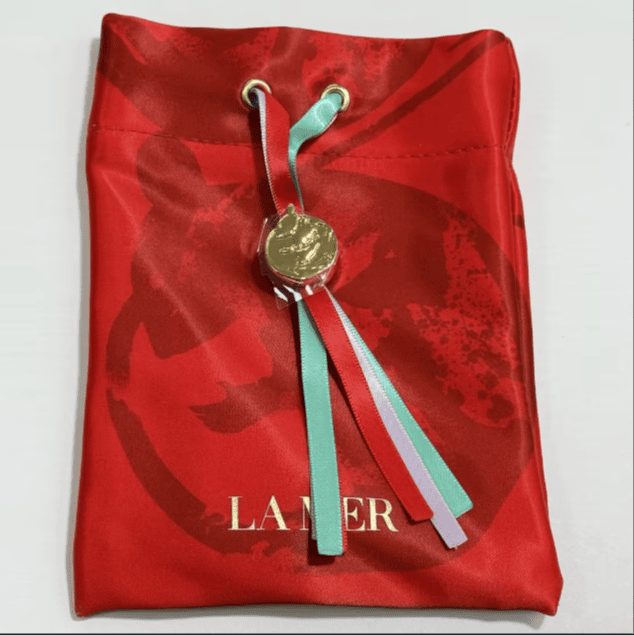
This case study walks through the real decisions, real trade-offs, and one production headache we solved along the way — so that promotional goods buyers sourcing custom drawstring bags for beauty, fashion, or lifestyle brands can benchmark what “luxury-grade” actually means at the factory level.
Quick Facts
- Fabric: 75D high-density imitation silk satin, approx. 120 g/m²
- Hardware: Zinc alloy gold pendant charm, plating thickness ≥ 0.03 µm
- Stitch density: 4.5 stitches/cm (premium garment standard)
- Eyelet inner diameter: 8 mm, precision-flanged thick-brass construction
- Ribbon abrasion resistance: Grade 4–5
- Quality standard: AQL 1.0 (critical) / AQL 2.5 (major), 100% pre-pack inspection
- MOQ: 1,000 pieces per colorway
- Certifications held: Sedex/SMETA (2-Pillar & 4-Pillar), SLCP, BCSI, SA8000
- Chemical compliance: Cadmium, lead, salt spray test (8/16/24 h), colour fastness to light
- Size: 16 × 12 cm
Why Material Choice Makes or Breaks a Luxury Custom Drawstring Pouch
La Mer’s brief was unambiguous: the bag had to read expensive the moment a VIP customer lifted it out of a gift box. That ruled out cotton canvas and standard plain-weave fabrics immediately — both feel rough against the fingertips and look flat under retail lighting, which is the opposite of what a prestige skincare brand needs at a holiday gifting moment.
The real choice was between standard low-density satin and a 75D high-density imitation silk satin. On paper they look similar. In practice, standard satin at lower thread counts is prone to snagging, pilling at seam edges, and — critically for this project — it cannot hold the full-coverage sublimation print without the pattern bleeding at the edges or the hand of the fabric turning stiff. The 75D high-density weave has enough warp-and-weft integrity to carry a complex ink-sublimation process while keeping the drape fluid and the surface mirror-bright. At approximately 120 g/m², it sits in the sweet spot between featherweight and structured: the bag holds its shape when standing on a vanity shelf but collapses flat for compact shipping.
For the inner lining, we used a compatible non-woven interlining to give the bag body without adding bulk. Polyester thread throughout — chosen for its colour stability and resistance to repeated handling rather than cost.
The Printing Decision: Why Digital Heat Transfer Won Over Screen Printing
The artwork La Mer supplied featured a full-coverage red ground with irregular ink-wash brushstroke motifs — the kind of artwork that looks deceptively simple but is actually one of the hardest briefs to execute on fabric. The tones shift from deep crimson to translucent blush in a single sweep, and there are at least three overlapping layers of colour at any given point in the design.
Screen printing (silk screen printing) was evaluated and rejected early. At the thread counts required to keep the gradient smooth, you need more screens, more registration passes, and even then the colour breaks are visible under close inspection — exactly the kind of thing La Mer’s QA team would flag on first sight. Screen printing also deposits a surface film of ink that sits on top of the satin fibres rather than bonding with them, which turns the printed area stiff, kills the drape, and leaves a slight rubbery handle that reads as cheap to any experienced quality controller.
Digital heat transfer printing at 1,200 dpi resolves both problems. The ink is sublimated into the fibre structure under heat and pressure rather than sitting on the surface, so the finished satin retains every gram of its natural drape and sheen. The colour gradient reproduces at photographic fidelity. There is no wastewater discharge in the process — a hard requirement for vendors supplying the Estée Lauder Companies under their environmental sourcing policy.
The front panel carries La Mer’s gold logo, applied by hot stamping rather than printing. Hot stamping on satin at the correct temperature (typically tighter tolerances than on paper or rigid substrates) produces a foil bond that is crisp at the edges and will not lift or flake through normal handling.
The Hardware: Custom Die-Cast Zinc Alloy Pendant
The gold medallion charm gathered at the mouth of the bag is the element that elevates this piece from a pouch to a collectible. It was designed from scratch: a 3D model was built first, the die was cut from that model, and the first zinc alloy die-cast samples were evaluated against the original render before any production metal was poured.
![Custom Satin Drawstring Bag – La Mer – Zinc Alloy Gold Pendant Hot Stamp Print]
The casting is plated to a minimum gold layer of 0.03 µm — thin enough to achieve the warm, rich tone La Mer specified, but applied with sufficient consistency that salt spray testing at 8, 16, and 24 hours shows no base metal breakthrough. Cadmium and lead content in both the alloy and the plating bath are tested to REACH restricted substances limits (see ECHA REACH restricted substances list for reference thresholds). The charm is designed to be detachable — customers who receive it as a GWP accessory can remove it from the ribbons and use it as a bag charm independently, which extends the perceived value of the gift well beyond a single skincare purchase.
The Eyelet Problem Nobody Talks About
Here is the production lesson that cost us one round of sampling before we got it right, and it is the kind of thing that only shows up after you have run friction testing on the actual ribbon-through-eyelet assembly.
On a satin drawstring bag, the eyelet — technically a flanged metal grommet punched and riveted through the bag mouth — is the single highest-wear contact point. The tri-colour ribbons (mint green, red, and pale lilac in this case) pass through the eyelet and are pulled thousands of times over a product’s life. Standard pressed iron eyelets or thin stamped-brass eyelets have a cut inner edge at the back face. That edge, even when it looks smooth to the naked eye, acts like a micro-saw on satin-weave ribbon under repeated friction. Within a few hundred cycles the ribbon develops pulled threads, fraying, and eventually splits at the contact point — a catastrophic defect on a luxury GWP item.
The fix is not complicated once you know it, but it is non-negotiable: we specified a precision-flanged thick-brass eyelet with an 8 mm inner diameter and a fully rounded, inward-rolled back edge. The internal profile is smooth enough that friction testing to Grade 4–5 ribbon abrasion resistance still shows no surface damage to the ribbon after the equivalent of ten thousand draw cycles. We now treat this as a standard specification on any satin or silk-look drawstring pouch — it is one of those details that never appears in a brief but always appears in a QA rejection report if you get it wrong.
Stitching Standard and Assembly Sequence
The full production sequence ran as follows:
3D hardware modelling and fabric pattern sampling → digital heat transfer printing of full-coverage ink-wash motifs → hot stamping of front-panel gold logo → needle-and-thread assembly joining inner non-woven lining to outer satin shell → punching and riveting of gold metal eyelets → threading of tri-colour satin ribbon drawstrings → assembly of zinc alloy gold pendant charm → trimming and full-inspection pressing → 100% dust-proof and scratch-resistant individual packaging.
Stitch density is held at 4.5 stitches per centimetre throughout. Interior seams are fully bound and enclosed — no raw edges visible when the bag is turned inside out, which is invariably one of the first things a brand QA inspector checks. Seam stress points at the eyelet girth are reinforced with a bartack stitch pattern.
This level of construction detail is consistent with our other work for the Estée Lauder group — you can see similar garment-grade sewing standards in our La Mer green velvet cosmetic bag case study and across the broader La Mer case archive.
Compliance, Chemical Testing, and Audit Credentials
Every batch of hardware and fabric that enters production for a luxury beauty brand account goes through incoming quality control (IQC) before any cutting or plating begins. For this project the testing programme covered:
- Cadmium and lead content in the zinc alloy casting and plating layer, verified against REACH Annex XVII restricted substance limits
- Salt spray test at 8-, 16-, and 24-hour intervals to check plating adhesion and base metal protection
- Colour fastness to light on the printed satin to confirm the red ground and ink-wash artwork will not fade under display lighting conditions
- In-process quality control (IPQC) at each assembly stage, with final quality control (FQC) and 100% pre-pack inspection before any unit enters a polybag
Outgoing shipments are inspected to AQL Level II: AQL 1.0 for critical defects (chemical non-compliance, structural failure, wrong logo) and AQL 2.5 for major defects (colour deviation, stitching skips, hardware alignment).
Our factory holds Sedex/SMETA 2-Pillar and 4-Pillar audit status, SLCP, BCSI, and SA8000 social compliance certification. If you are sourcing for a multinational brand whose procurement team will require ethical audit documentation before issuing a purchase order, these credentials remove a significant administrative burden. For buyers who are new to the difference between these frameworks, our article on BSCI and Sedex: what they are and how they differ gives a clear overview. We have also written specifically about the SMETA audit process and common buyer questions for teams that are preparing a vendor qualification file.
ESG red lines we enforce internally: no discharge of heavy-metal-bearing wastewater, full compliance with REACH/CA65 restricted substance limits, zero illegal disposal of electroplating sludge, and no use of GRS-certified recycled material claims without verified chain-of-custody documentation.
Packaging and Logistics Specification
Each finished bag is individually wrapped in tissue paper (防刮拷贝纸) to protect the satin surface and the plated hardware from contact scratches and oxidation. The tissue-wrapped unit is then sealed in an eco-friendly, high-clarity PE polybag.
Export cartons are 160 g/m² double-wall A-flute corrugated board, with a strict 10 kg per-carton weight ceiling and full interior moisture-barrier lining. These specs align with the receiving requirements of major centralised brand distribution warehouses — the kind of inbound standards that La Mer’s logistics team applies to every GWP shipment regardless of origin.
If you are working with a brand that operates first-party warehouse receiving (as most Estée Lauder group divisions do), we can provide a full packaging spec sheet prior to production sign-off so your QA and logistics teams can sign off in advance.
Customisation Options for Promotional Goods Buyers
Custom drawstring bags of this type can be configured across a fairly wide range of variables without requiring a full re-tool of every component. Fabric weight, base colour, and print artwork are the most common variables. Hardware finishes — antique gold, matte gold, antique silver, gun metal, imitation rhodium — can be specified per the plating colour chart. Ribbon colour combinations can be matched to Pantone references. Logo application method (hot stamping, heat transfer, embossing) is chosen based on the fabric surface and the brand’s visual identity standards.
For buyers sourcing custom printed drawstring bags or a customised drawstring bag programme across multiple SKUs or seasonal colourways, we recommend consolidating tooling (the zinc alloy die and any custom eyelet tooling) across the full run to optimise unit economics. MOQ for this product category starts at 1,000 pieces; all other commercial terms — pricing, tooling costs, sample lead time — are quote-based. Please contact us for a detailed quotation.
For buyers comparing this format against a more structured cosmetic pouch, our La Mer custom metal keychains case study and the Estée Lauder case archive illustrate how we handle hardware-heavy GWP accessories for the same brand family.
When sourcing drawstring bags bulk for a seasonal campaign, lead time and pre-production sampling schedule are the two variables that most often compress at the end. We build both into the project timeline at quotation stage.
FAQ
Q: Will the red satin fabric bleed colour onto white clothing or cosmetic products if it gets wet?
The ink-wash motifs and the base red tone are applied via digital heat transfer sublimation, which bonds the dye into the fibre structure rather than leaving a surface coating. Prior to production sign-off, colour fastness to light testing is conducted, and wash/rub fastness is assessed as part of the fabric QC programme. That said, as with any deeply pigmented fabric, we recommend that the finished bag be kept away from prolonged direct contact with white or pale garments in humid conditions. Colour fastness test data from the specific production batch is available upon request with any bulk order.
Q: Will the gold finish on the zinc alloy pendant chip, scratch, or wear off with regular use?
The pendant is plated to a minimum gold layer of 0.03 µm and passes salt spray testing at 8, 16, and 24 hours without visible base metal exposure. Routine decorative use — handling, light contact with other accessories — will not damage the finish under normal conditions. The plating is not the same grade as fine jewellery, and it is not positioned as such: it is a prestige promotional hardware piece engineered to look pristine throughout the GWP product’s expected use cycle. Cadmium and lead content are tested to REACH limits.
Q: Does the factory support mid-production inspection and container loading supervision?
Yes. We support third-party inspection access at in-process quality control (IPQC) stage and at final quality control (FQC) / pre-shipment stage. Container loading supervision (container stuffing inspection) can be arranged through any accredited inspection agency the buyer nominates. We will co-ordinate access and provide packing lists and carton labelling in the format your logistics team requires.
Q: What audit and social compliance certifications does the factory hold?
The factory holds Sedex/SMETA 2-Pillar and 4-Pillar audit status, SLCP, BCSI, and SA8000 certification. These cover labour standards, health and safety, environmental practices, and business ethics across the full supply chain. Audit reports and SMETA summary documentation are available to qualified buyers under NDA. For an explanation of how SMETA and BSCI relate to each other, see our overview at what are BSCI and Sedex and what are their differences. On large-volume quality issues, our position is: we stand behind our production. Any remediation or replacement arrangement would be assessed on the specific defect finding; please discuss terms with our sales team at quotation stage rather than after the fact.
About Top Jewelry
Top Jewelry is a factory-direct manufacturer of custom promotional accessories and fine-adjacent custom drawstring bags, specialising in GWP programmes for luxury beauty, fashion, and FMCG brands. Our production holds Sedex/SMETA (2-Pillar and 4-Pillar), SLCP, BCSI, and SA8000 credentials, and all metal components are tested to REACH and CPSIA restricted substance requirements (see US CPSIA for US market reference). We have supplied La Mer, Estée Lauder, and related Estée Lauder Companies divisions across multiple seasonal programmes. Our approach is straightforward: every spec decision is documented, every quality gate is recorded, and every shipment is traceable.
If you are developing a seasonal GWP programme, a branded retail pouch, or a custom drawstring pouch for a luxury or premium consumer brand, we would be glad to review your brief and prepare a detailed quotation. Contact us here — send us your artwork, your target quantity, and your delivery window, and we will come back with a full production proposal.