
As a Sedex/SMETA-audited manufacturer supplying custom lapel pins to luxury brands including L’Oréal, we know the gap between a brooch that looks like a collector’s piece and one that looks like a convention giveaway comes down to three decisions made before a single die is cut.
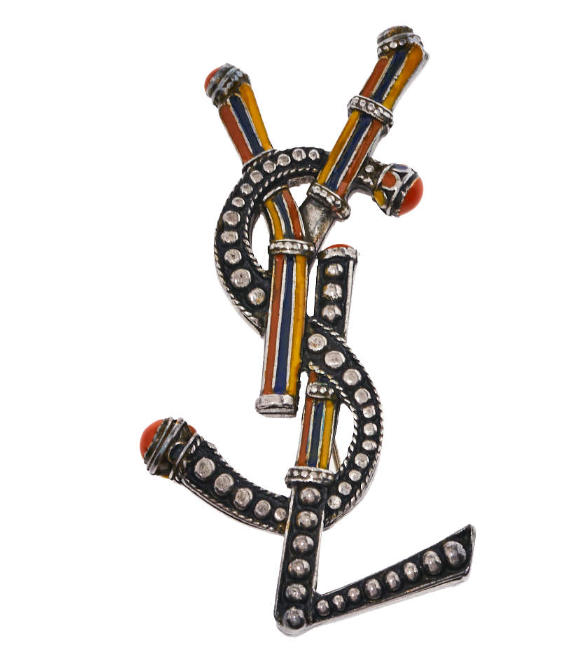
This case study walks through a real YSL-branded brooch we produced for L’Oréal’s promotional gifting program — the material call, the 10-plus production steps, the one color-control problem that nearly derailed the schedule, and how we hit 99% color accuracy in the final run.
Quick Facts
- Material: Brass body + soft enamel fill + cubic zirconia stone-setting
- Dimensions: 3.60 cm wide × 7.40 cm tall
- MOQ: 500 pieces
- Color accuracy achieved: 99% (full inspection before packaging)
- Quality standard: 100% pre-shipment inspection + AQL Level II sampling
- Compliance tested: Lead (Pb) and Cadmium (Cd) per REACH/CPSIA requirements
- Audit credential: Sedex / SMETA 2-Pillar and 4-Pillar
Why Brass — and Not Stainless Steel or Zinc Alloy
The first conversation with the L’Oréal team was about substrate. They came in with a mood board full of heritage textures: rope-wound edges, raised dot borders, tubular enamel channels that referenced bamboo. That surface language only works on brass.
Stainless steel is too hard to accept the fine engraving detail, and its surface energy resists the antique oxidized finish that gives brass its characteristic darkening in recessed areas. Zinc alloy can replicate some relief work, but the grain structure after die casting isn’t tight enough to hold a clean antique silver result — you get blotchiness around the dot borders rather than the crisp shadow-and-highlight contrast the YSL design demanded. Brass, by contrast, takes the antique plating and then the oxidized treatment evenly, and the result reads as genuinely aged rather than artificially dipped.
That material decision shaped every downstream step.
The Production Route: More Than Ten Steps, Each One Consequential
Die casting a badge is common. Producing this brooch required a different route: lost-wax casting (also called investment casting — a process where a wax model is encased in ceramic shell, burned out, and replaced by molten metal, yielding finer surface detail than standard die casting).
The full sequence ran:
3D modeling → lost-wax casting → rough hand-polishing → fine hand-polishing → antique electroplating → oxidized finish → soft enamel filling → cubic zirconia stone-setting → inspection → packaging
Two passes of hand-polishing matter here. Rough polishing removes the casting skin and levels the relief planes. Fine polishing brings the raised dot borders and rope edges to a specific reflectivity — not mirror-bright, because that would undercut the antique gold effect, but smooth enough that the plating adheres without orange-peel texture.
The antique electroplating step deserves a paragraph on its own. Standard bright plating — the kind that makes fast-fashion pins look glossy and new — flattens the visual hierarchy of the piece. Antique electroplating applies a base coat that is then selectively oxidized: the recessed areas darken while the high points retain their metallic sheen. The result is the year-worn, museum-quality depth the L’Oréal brief required. Bright plating on this design would have made a 7.40 cm brooch look like a souvenir badge; antique plating made it look like something from a YSL archive.
The Hardest Part: Keeping Soft Enamel Colors from Bleeding
Here is the part of this job nobody talks about in a brochure.
The brooch carries narrow enamel channels — three colors (amber yellow, navy blue, and terracotta orange-red) running in parallel stripes along the tubular bamboo elements. The channels are separated by thin brass walls. When enamel is applied by hand and then cured, heat causes each color to soften and flow slightly. If the wall between the amber and the navy is not perfectly clean and the cure temperature is even a degree or two high, the colors migrate into each other.
The biggest production challenge on this piece was color bleeding: keeping the amber, navy, and terracotta from contaminating each other during the enamel cure cycle. We solved it by enforcing three controls simultaneously. First, the brass partition walls were polished to a consistent height so there was no low point for color to flow over. Second, oven temperature was calibrated to the narrowest safe window for this color combination. Third — and this is the one that made the real difference — we raised the patrol inspection frequency to 50% during the enamel stage. Standard IPQC (in-process quality control) on a typical enamel pin runs at 10–20% checks per hour. For this job, one inspector reviewed every other tray coming out of the curing oven.
The outcome: color accuracy reached 99% across the production run. That number came from our FQC (final quality control) full inspection before packaging — every single piece, not a sample.
Combining Soft Enamel and Cubic Zirconia: A Note on Sequence
After enamel, cubic zirconia stones are set by hand into pre-cast seats at the terminal caps of each bamboo tube element. The stone-setting always comes after enamel cure, never before. Enamel curing temperatures would damage the adhesive bond and potentially discolor the stones. Buyers ordering a combination piece like this for the first time sometimes ask why the lead time is longer than a plain enamel pin — this sequencing is the reason. You cannot compress the two operations into a single pass.
For buyers sourcing custom enamel pins with mixed materials, building this sequential buffer into your production calendar is worth doing from day one.
Compliance: Lead and Cadmium Testing
Promotional jewelry entering the EU and North American markets faces mandatory restrictions on lead and cadmium content. The ECHA REACH restricted substances list caps cadmium in metal alloys at 0.01% by weight and restricts lead in jewelry sold to the general public. The US CPSIA sets a 100 ppm lead content limit for children’s products and applies broader lead surface coating rules across categories.
For this YSL piece, both lead and cadmium were tested at third-party labs on the finished plated articles. The brass substrate and all plating solutions were pre-qualified before production started — catching a non-compliant plating bath at the raw-material stage (IQC, or incoming quality control) is far cheaper than a failed finished-goods test.
Factory Compliance and Ethical Sourcing
L’Oréal’s supplier qualification process is one of the most thorough in the beauty and luxury gifting sector. They require Sedex/SMETA audit coverage before a factory can be approved, and their ESG red lines include a zero-tolerance position on child labor.
Our facility holds both Sedex 2-Pillar and 4-Pillar SMETA audit qualifications. If you want to understand what those audit tiers actually cover and why luxury buyers insist on 4-Pillar specifically, our page on what SMETA is and how it works explains the framework plainly.
For context on how L’Oréal structures its sourcing requirements across supplier categories, see why L’Oréal launched its Inclusive Sourcing Program — it gives a clear picture of what a Tier-1 beauty brand expects from its promotional gifts supply chain.
We have also produced custom metal pins and branded accessories for Giorgio Armani and Lancôme, both of which carry similar audit and compliance requirements.
The Finished Piece: What It Looks Like and How It Ships
The finished brooch is 3.60 cm wide and 7.40 cm tall — compact enough to sit on a jacket lapel without overwhelming the collar, substantial enough to read clearly on product photography. The antique silver base coat darkens the rope-wound and dot-bordered frame while the soft enamel stripes — amber, navy, and terracotta — stay vivid inside their channels. The cubic zirconia caps at each bamboo terminal catch light without competing with the enamel. The piece looks collected, not manufactured.
Each brooch ships in a black silk drawstring pouch nested inside a black gift box. For a luxury promotional gift that may be handed to a VIP customer or included in a seasonal gift set, the unboxing experience matters as much as the product itself.
Working With Us as Your Custom Lapel Pin Manufacturer
This project is representative of the work we do for promotional gifting teams at major beauty and fashion houses. If you are sourcing custom enamel lapel pins for a brand campaign, a retail loyalty program, or a trade show premium, the questions worth asking any enamel pin maker before committing to a production run are: Can they do antique finishing in-house? Do they have SMETA audit coverage? Do they test lead and cadmium on finished goods rather than just on raw materials?
We can answer yes to all three.
Minimum order quantity for a project like this starts at 500 pieces. All pricing — including any charges related to tooling, logo customization, packaging, and sampling — is quote-based. Please contact us for a detailed quote.
FAQ
Q: Does adding a custom logo or custom color box cost extra?
All customization costs — including logo tooling, packaging design, and custom color boxes — are quote-based and depend on specification details such as artwork complexity and packaging construction. Please contact us with your brief and we will provide a full itemized quote.
Q: Why does this brooch need lost-wax casting instead of standard die casting?
Die casting uses a rigid steel mold and suits high-volume, lower-detail pieces. Lost-wax casting uses a wax pattern burned out of a ceramic shell, which allows undercuts, rope textures, and fine dot borders that die casting cannot cleanly reproduce. For a design with the surface complexity of a YSL archive piece, lost-wax casting is the only route that delivers the intended detail.
Q: What compliance testing is done on the finished brooch?
Lead (Pb) and cadmium (Cd) are tested on finished plated articles at third-party laboratories. Raw materials and plating solutions are pre-qualified at IQC stage. The finished-goods test covers the actual plated surface the end consumer contacts, not just the base metal. This approach aligns with REACH and CPSIA requirements.
Q: How do you prevent soft enamel colors from bleeding into each other on multi-color designs?
Three controls run simultaneously: partition wall height consistency (polished to a uniform level so no low point allows color flow), oven temperature calibration to a narrow window for the specific color combination, and elevated IPQC frequency — we ran 50% patrol inspection during the enamel stage on this project, against a typical rate of 10–20%. The result was 99% color accuracy on the finished run.
About Top Jewelry
Top Jewelry is a factory-direct manufacturer of custom promotional jewelry and branded accessories, supplying luxury and beauty houses including L’Oréal, YSL, Giorgio Armani, and Lancôme. Our facility holds Sedex/SMETA 2-Pillar and 4-Pillar audit qualifications. All production complies with REACH restricted substance limits and CPSIA lead requirements. We operate 100% pre-shipment full inspection and AQL Level II sampling as standard on every order.
Ready to discuss your next custom lapel pin project? Request a quote here.