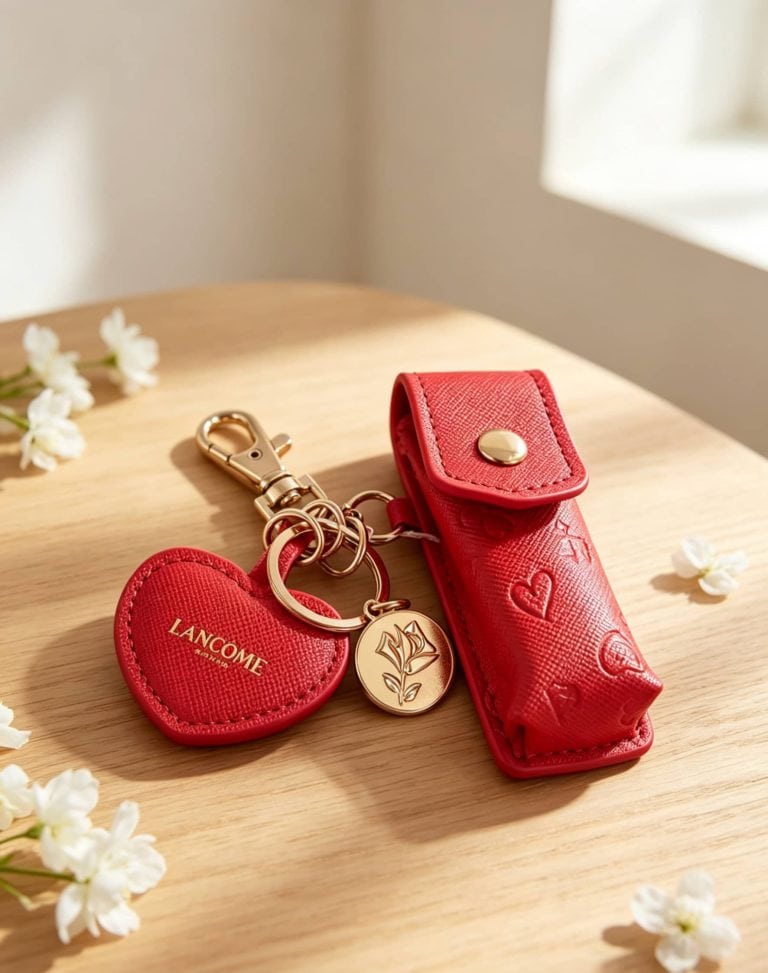
As a Sedex/SMETA-audited and ISO 9001-certified manufacturer supplying promotional gifts to luxury beauty brands, we’ve produced some memorable gift-with-purchase pieces over the years. The Lancôme project — a heart-shaped PU leather keychain paired with a Saffiano-embossed mini lipstick pouch — stands out not because the brief was simple, but because it wasn’t.
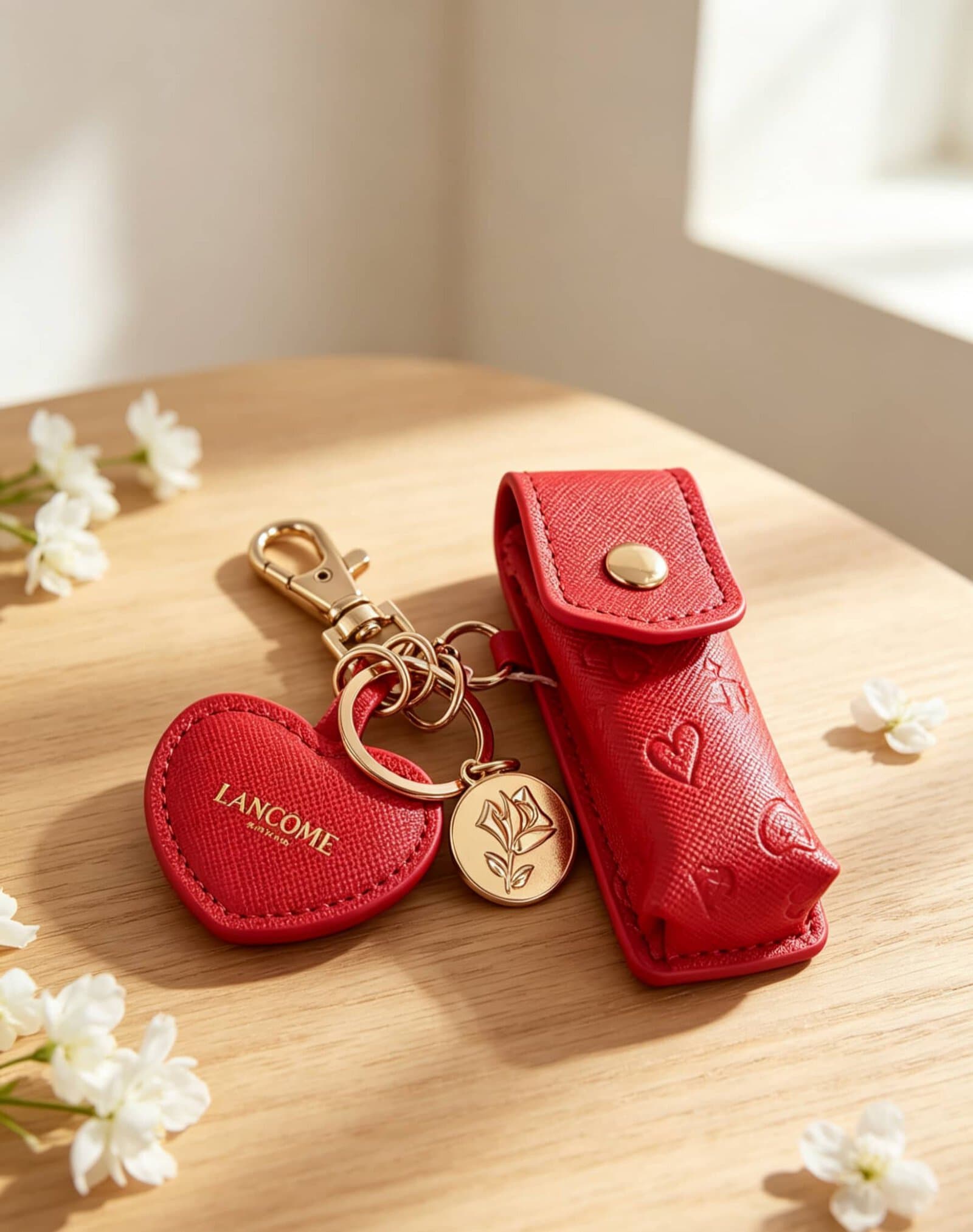
This piece walks through exactly how we brought it to life: material selection trade-offs, a production problem that cost us two sample rounds before we cracked it, and the compliance checks that L’Oréal’s supply chain team required before a single unit shipped.
Quick Facts
- Material: Zinc alloy hardware + 1.4 mm Saffiano-grain PU leather (vegan, eco-friendly)
- Hardware finish: Imitation gold electroplating with lacquer topcoat — passes 48-hour salt spray test at Grade 8 or above
- Stitching: 9 stitches per inch, French-seam style, hand-finished oil edges
- MOQ: 1,000 pieces
- Production lead time: 30–35 working days after sample approval
- Compliance testing: Lead, cadmium, nickel, AZO dyes, phthalates, salt spray (8/16/24 h panels)
- Certifications: ISO 9001, Sedex/SMETA (2-Pillar and 4-Pillar), L’Oréal audited supplier
Why Lancôme Chose PU Over Genuine Leather — and Why We Agreed
When the L’Oréal procurement team first briefed us on this GWP (gift-with-purchase), genuine leather was on the table. We pushed back, and here’s why.
Genuine leather carries a significantly higher unit cost at the quantities a mass GWP campaign demands. Beyond budget, there’s a texture inconsistency issue: natural hides have grain variations batch to batch, which makes color-matching across thousands of units far harder than it sounds. There’s also the animal welfare dimension — the brand’s European consumer base is increasingly vocal about vegan and cruelty-free sourcing, and launching a luxury gift item made from animal skin creates a real reputational risk in markets like France, Germany, and the UK.
High-grade Saffiano PU — the cross-hatch textured leather you recognize from Prada accessories — resolves all three problems at once. It replicates the visual weight and structural stiffness of premium leather goods at a fraction of the raw material cost. It’s scratch-resistant by design, which matters enormously for a keychain that will live on a handbag or in a pocket. And it qualifies as vegan leather, fitting neatly into the eco-friendly positioning L’Oréal has been building across its brand portfolio. You can read more about how L’Oréal structures its inclusive sourcing requirements in this overview of the L’Oréal Solidarity Sourcing Program.
We also tested plain smooth PU before the Saffiano decision was final. The smooth surface showed fingerprints immediately, scratched with a thumbnail, and — critically — the embossing of the heart and rose motifs deformed and partially rebounded within 48 hours at room temperature. Saffiano’s cross-hatch structure acts as a mechanical anchor for deep embossed patterns, keeping them crisp and dimensionally stable across the product’s service life.
The Embossing Problem Nobody Warned Us About
Here is the part of this project I’d want every GWP buyer to hear before they sign off a sampling brief.
When we ran the first round of leather samples, the heart outline and the rose watermark pattern came out inconsistent — some units had sharp, deep impressions while others were nearly flat in the center. The pattern looked uneven under retail lighting, which is exactly the condition a product like this gets judged under on a cosmetics counter display.
The root cause: temperature and pressure distribution across the embossing die were not uniform. A standard hydraulic press has hot spots and cool spots across its platen, and on a 1.4 mm Saffiano panel that variation translates directly into shallow imprints in cooler zones and slightly crushed fiber in hotter ones.
We solved this by switching to a high-precision pneumatic embossing press, locking the mold temperature at a steady 115°C, and holding dwell pressure for exactly 3.5 seconds per cycle. The result was 100% pattern consistency across the production run — no rebound, no wrinkling, no variation in motif depth between the first piece and the last. That fix cost us two additional sample rounds and about a week, but it was non-negotiable for a brand at Lancôme’s visual standard.
Leather edge finishing went through a similar debate internally. A raw cut edge (what the industry calls a “raw edge” or “rough edge”) is the fastest and cheapest option but frays with use. A folded edge (turning the leather inward and stitching it down) adds structure but adds thickness that fights against the sleek profile the client wanted. We went with oil edge finishing — where a resin-based edge paint is applied in multiple coats and burnished smooth — which gives a durable, polished result at 1.4 mm material thickness without adding bulk.
Hardware: Zinc Alloy Die Casting and the Electroplating Stack
The rose charm and the lobster clasp are die-cast zinc alloy, which is the standard choice for promotional jewelry hardware: dimensionally precise, detail-capturing in a steel mould, and light enough that the assembled keychain doesn’t feel heavy on a handbag.
The finish is imitation gold electroplating — a multi-layer stack that goes copper strike → nickel barrier → gold-tone flash, then sealed with a lacquer topcoat. That topcoat is what gives the hardware its resistance to perspiration and oxidization in daily carry conditions. We tested the finished hardware on a salt spray (salt testing) rig at 8, 16, and 24 hours as standard, and the Lancôme batch also passed a full 48-hour cycle at Grade 8 — meaning no blistering, no peeling, and no base metal exposure at the cut edges.
The Lancôme brand name on the heart panel uses hot stamping (a heated metallic foil is pressed into the surface via a copper die). Because the heart shape is a recurring design element across Lancôme’s GWP catalog, we engineered the copper stamping plate as a reusable tooling asset rather than a dedicated injection mould. That kept the tooling cost well below what a full-sized plastic mould would require — specific pricing is quote-dependent, please contact us for an accurate figure for your project.
Logo clarity hit 100% across all inspected units, which is a number we track explicitly because hot stamping on textured PU can suffer foil drop-out at the cross-hatch intersections if temperature or dwell time is off.
Material Optimization: Cutting Waste From 25% to 12%
One of the more unglamorous but commercially meaningful parts of this project was leather yield optimization. The heart shape and the rectangular lipstick pouch are geometrically inefficient to cut individually — both leave significant edge waste when nested conventionally on a PU roll.
Our pattern engineering team used nesting software to interlock the heart pendant panels and the pouch body panels on the same PU sheet, rotating and staggering them to fill the gaps each shape leaves behind. That reduced our raw material scrap rate from a typical 25% down to under 12% — a meaningful cost reduction at GWP volumes, and a genuine sustainability improvement in terms of material waste per unit.
Compliance Testing: What L’Oréal’s Supplier Standards Actually Require
L’Oréal is one of the more demanding beauty conglomerates to supply to, and that’s a feature rather than a complaint. Their supplier qualification process touches every material in the product.
For the metallic components, we ran lead and cadmium testing (both restricted under REACH regulations and the US CPSIA), nickel release testing, and AZO dye screening. For the PU leather, phthalate content was tested — relevant because PU plasticizers in some lower-grade materials carry phthalates that exceed EU limits. Salt spray testing covered 8, 16, 24, and 48-hour intervals to validate the electroplating stack under accelerated corrosion conditions.
Internally, our quality flow runs: IQC (incoming material inspection) → IPQC (in-process roving inspection at each production stage) → 100% pre-packing final inspection → AQL Level II sampling inspection on packed goods. Nothing ships without a full FQC sign-off.
Factory Credentials: Why Sedex/SMETA Matters to GWP Buyers
Lancôme’s parent company L’Oréal requires its promotional gift suppliers to hold Sedex membership and pass SMETA audit (Supplier Ethical Data Exchange / Sedex Members Ethical Trade Audit — an internationally recognized social compliance framework covering labor standards, health and safety, environment, and business ethics). We hold both 2-Pillar and 4-Pillar SMETA status. If you’re unfamiliar with the difference between 2P and 4P audits, this explainer covers it clearly.
Our factory has zero tolerance for forced labor and child employment — both are absolute disqualifiers in our hiring and subcontracting policies, and both are audited by SMETA assessors during each audit cycle. More background on what SMETA actually examines is at our SMETA overview page.
We also hold ISO 9001 quality management certification, which governs the documented procedures behind our IQC, IPQC, and FQC processes. For buyers evaluating factory credentials across multiple suppliers, this comparison of BSCI and Sedex is a useful reference.
Packaging: OPP Bag to Export Carton
Every assembled keychain goes into a custom OPP bag — optically clear, anti-static, printed with the required suffocation warning language per EU and US retail standards. A white card insert sits inside the bag to keep the leather panel flat during transit and storage. The bags are then repacked into moisture-barrier bubble bags, and those go into a five-layer reinforced export carton. Carton weight is held strictly at 15 kg or below, which keeps the shipment compliant with Amazon FBA inbound requirements and European beauty warehouse handling limits.
This is the kind of packaging spec that sounds like background noise until a batch gets rejected at a fulfillment center. We’ve been through those conversations with other clients and built the spec accordingly.
What This Means for Buyers Sourcing Wholesale Custom Keychains
If you’re sourcing wholesale custom keychains for a brand promotion, a corporate gift campaign, or a loyalty program, the Lancôme project is a reasonable benchmark for what a well-executed GWP keychain looks like: multi-function design (bag charm plus functional pouch), premium material and hardware, full compliance documentation, and packaging engineered for modern fulfillment logistics.
We handle custom keychains bulk orders from concept through delivery — 3D modeling, steel mould making, die casting, electroplating, leather cutting, embossing, stitching, oil edge finishing, hardware assembly, and 100% final inspection. Personalized keychains bulk orders with brand logos, custom shapes, or photo-etched charms (customised keychain with photo techniques use laser engraving or chemical etching onto the metal charm surface) follow the same production flow.
You can browse more Lancôme projects in our Lancôme case portfolio, or explore how we’ve worked with other L’Oréal group brands in our L’Oréal case archive and Kiehl’s case collection.
FAQ
Q: What certifications does your factory hold — BSCI, Sedex, ISO 9001?
We hold Sedex membership and have passed SMETA audit at both 2-Pillar and 4-Pillar levels. We are ISO 9001 certified. We have supplied L’Oréal group brands including Lancôme directly as an audited vendor. If your procurement team requires a specific audit report or certificate copy, please contact us and we’ll provide what’s available for your qualification process.
Q: How long does production take, and what happens if delivery is delayed?
Standard lead time after sample approval and deposit receipt is 30–35 working days. Delivery commitments and any applicable late-delivery terms are set out in the formal purchase order and contract; please contact us to discuss your timeline and we’ll confirm what’s feasible for your volume and spec.
Q: Will the electroplating fade or chip? Are the alloy parts nickel-free and lead-free?
The imitation gold electroplating on our zinc alloy hardware uses a multi-layer stack finished with a lacquer topcoat. The Lancôme batch passed a 48-hour salt spray test at Grade 8 or above. We test all metallic components for lead and cadmium under REACH standards and for nickel release under EU Nickel Directive limits. Test reports are available on request. Specific alloy formulations are confirmed at the quotation stage — please contact us for details.
Q: Is the PU leather eco-friendly, and can you provide test reports?
The Saffiano-grain PU we use is vegan leather — no animal materials, no animal by-products. We test for phthalates and AZO dyes, and reports from third-party labs are available for qualified buyers. Specific eco-certifications depend on the PU grade selected for your project; pricing and material specs are quote-based, so please contact us to discuss your requirements.
Q: What is the minimum order quantity for wholesale custom keychains?
MOQ for this type of multi-component PU leather and zinc alloy keychain is 1,000 pieces. For other keychain configurations the MOQ may differ — pricing and MOQ are always confirmed in the formal quotation, so please contact us with your design brief for an accurate figure.
About Top Jewelry
Top Jewelry is a factory-direct manufacturer of custom promotional jewelry and accessories, supplying luxury beauty brands, fashion houses, and corporate gifting programs worldwide. Our production facility holds ISO 9001 certification and Sedex/SMETA audit status (2-Pillar and 4-Pillar), and we are a qualified vendor for L’Oréal group brands. All products are tested to REACH and CPSIA standards for restricted substances including lead, cadmium, nickel, AZO dyes, and phthalates. We manufacture everything from wholesale custom keychains and enamel pins to brooches, bracelets, and full gift sets — with a quality system built to satisfy the most demanding global compliance requirements.
Ready to start your own keychain project? Whether you need 1,000 pieces or 100,000, we’d like to see your brief. Request a quote here and our team will come back to you with material options, a production timeline, and a detailed cost breakdown.