When sourcing the right keychain vendors, professional buyers look beyond the surface. It’s not just about the product; it’s about a supplier’s technical depth, quality control rigors, and compliance standing. With over 25 years of OEM/ODM experience, Top Jewelry takes you inside the production line to deconstruct the manufacturing process from a professional perspective.
01. Core Forming Processes: The Foundation of Supplier Evaluation
A professional keychain vendor must master diverse forming technologies to meet needs ranging from mass-market promotional giveaways to high-end retail merchandise:
1. Stamping & Die-Casting — The Heart of Metal Hardware
This is the benchmark for supplier capability, particularly when working with hard metals like stainless steel and zinc alloy.
Real-World Case (The La Mer Project):While producing zinc alloy enamel keychains for La Mer, our primary challenge was achieving near-perfect brand color reproduction. Metal surfaces often experience color shifts during the curing process. To solve this, we optimized the surface tension of the electroplating layer and customized the pigment ratios.This allowed us to control the color deviation () within a 0.6–0.9 range, meeting luxury-grade precision standards.
https://www.top-jewelry.net/custom-metal-keychains-lamer-case-study/
2. Injection Molding — High Volume & 3D Customization
This is the standard for creating custom PVC keychains and 3D brand mascots.
• Capacity Advantage: Top Jewelry operates multiple fully automated injection molding machines with a monthly capacity of 500,000 units. This scale ensures on-time delivery for large-scale events even when working with complex 3D soft rubber designs.
3. Die Cutting — Precision for Soft Materials
Best suited for leather and soft rubber sheets. We utilize high-carbon steel dies to ensure that products like our Leather Picture Keychains have clean, burr-free edges, providing the premium tactile experience high-end brands require.
02. Buying Guide: Process Comparison & Decision Making
We recommend selecting your manufacturing process based on the following technical dimensions:
| Process | Recommended Materials | Key Advantages | Best Use Case | Cons | Cost Range | MOQ |
| Die-Casting/ Stamping | Zinc Alloy, Stainless Steel | Premium feel, extremely durable | Automotive, high-end corporate gifts | Higher mold costs; slower than injection | Mid – High | 1,000+ |
| Injection Molding | PVC, ABS | Ideal for complex 3D shapes; low unit cost | Brand mascots, mass promotions | Expensive molds; difficult to modify | Highly Competitive | 2,000+ |
| Die Cutting | Leather, Microfiber | Short lead times; vintage aesthetic | Cultural/Creative products, fashion brands | Limited 3D detail; relatively thin feel | Low – Mid | 500+ |
03. Surface Finishes: Giving the Keychain “Soul”
Forming is only the first step. We use the following techniques to increase a product’s perceived value:
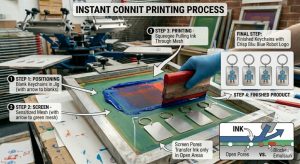
• Screen Printing: The classic choice. Ink is transferred through a sensitized mesh. It is ideal for logos with solid, distinct blocks of color.
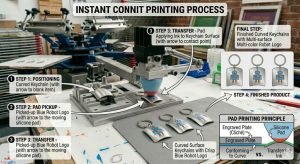
• Pad Printing: Uses a silicone pad to “transfer” patterns onto irregular surfaces. This is the go-to method for multi-color overprinting on curved or very small areas.
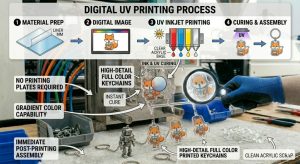
• Digital UV Printing: The preferred method for custom acrylic keychains. Since acrylic is highly transparent, UV printing allows for full-color, high-resolution graphics and gradients without the need for physical plates.
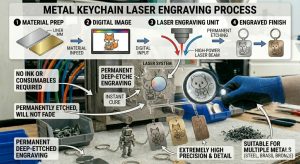
• Laser Engraving: Permanent etching into the surface. These markings will not wear or fade, giving metal keychains a minimalist, high-end finish.
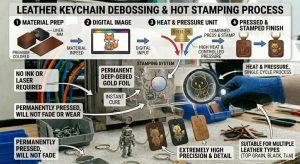
• Debossing & Hot Stamping: Primarily used for leather. Debossing creates a physical indentation, while hot stamping uses heat to transfer gold or silver foil onto the surface for a luxury vintage look.
04. Why Partner with Top Jewelry?
• Jewelry-Grade Quality Control: While the industry standard is often AQL 2.5 sampling, we perform 100% manual inspections on critical elements like enamel filling and laser engraving. Our internal failure threshold is strict: any enamel overflow exceeding 0.2mm is rejected.
• International Compliance: We are certified by Sedex (4-Pillar), Disney FAMA, and GRS (Global Recycled Standard). To help brands meet their ESG goals, we commit to using 100% recyclable 304 stainless steel components.
• Strict Environmental Testing: All materials are REACH compliant. We pass third-party testing for Nickel and Lead (REACH, EN1811, EN12472), with release limits maintained below 0.5µg/cm²/week.
https://echa.europa.eu/candidate-list-table
• Durability Testing: For electroplated finishes, we conduct 48-hour salt spray tests to simulate high-humidity environments. Our custom metal keychains consistently achieve a Grade 10 rating (the highest level) according to ISO 9227 standards.
https://www.iso.org/standard/81744.html
Contact us to get free design proposals and quotes tailored to your brand’s tone and style.
Contact us:https://www.top-jewelry.net/contact-us/
05. Frequently Asked Questions
What should I look for when evaluating professional keychain vendors?
You should prioritize manufacturing depth, international compliance certifications (such as Sedex or Disney FAMA), and a proven track record with high-stakes projects, like our work for La Mer.
How long does it take to manufacture custom keychains?
The typical lead time is between 15 and 25 days, depending on the complexity of the design and the total order volume.
Do you offer eco-friendly material options?
Yes, we provide GRS-certified recycled materials and 100% recyclable stainless steel options to support sustainable branding.
What is the minimum order quantity (MOQ) for custom orders?
Our MOQ generally starts between 500 and 1,000 pieces, depending on the specific manufacturing process required.
What materials are best for high-volume promotional keychains?
PVC and acrylic are the best choices for promotions. They offer the best balance of cost-effectiveness, durability, and versatility for custom branding.