Whether you are a jewelry enthusiast or a brand manager, one critical question often arises when selecting materials: does zinc alloy tarnish? This comprehensive guide explores the tarnishing characteristics of zinc alloy, how it compares to other metals, and the best practices for maintaining its finish. As a professional zinc alloy manufacturer with 28 years of deep industry expertise, TOP JEWELRY believes that buyers need to know not only “if” it tarnishes, but more importantly, “how to control” it.
I. What is Zinc Alloy and Why is it Used in Jewelry Making?
Zinc alloy is a highly versatile material created by combining zinc with other metals, such as copper, aluminum, and magnesium. This specialized combination yields enhanced physical properties compared to using pure zinc alone. The resulting alloy features a crystalline structure that offers an ideal balance of moderate ductility and strength, making it perfectly suited for jewelry manufacturing applications.
II.Why Does Zinc Alloy Remain an “Evergreen” Choice in Jewelry Manufacturing?
Before discussing tarnishing, it is crucial to understand why top-tier global buyers continue to seek out high-standard zinc alloy manufacturers.
- Exceptional Cost-Effectiveness: Compared to precious metals like gold and silver, zinc alloy holds an overwhelming advantage in raw material costs, allowing brands to achieve scalable mass-market expansion while maintaining high gross margins.
- Processing Flexibility: Zinc alloy boasts a lower melting point and excellent machinability. This results in reduced machine wear and significantly higher yield rates than copper or stainless steel when manufacturing complex, intricate structures.
- Visual Expression: Through techniques like electroplating, painting, and enamel dripping, zinc alloy can flawlessly replicate a vast array of finishes—from 18K real gold to vintage antiqued looks—offering brands nearly limitless stylistic options.
- Natural Corrosion Resistance: When exposed to air, zinc alloy naturally develops a dense, protective passivation film. This spontaneous barrier gives it more stable rust resistance than pure copper under standard wearing conditions.
- Ultimate Shaping Capabilities: Because it exhibits exceptional fluidity during the die-casting phase, zinc alloy can achieve intricate 3D reliefs and complex cut-outs that are simply impossible with stainless steel.
- The Commercial Balance: It delivers the visual impact of precious metals while keeping mold development costs at roughly half those of stainless steel, making it an outstanding solution for rapid product testing.
- Optimal Wearability: The material possesses a moderate weight, making it capable of supporting large, dramatic statement earrings without causing strain on the wearer’s earlobes.
Ultimately, zinc alloy provides jewelry designers with tremendous creative flexibility while keeping production costs firmly in check. This makes it the material of choice for fast fashion jewelry, apparel accessories, and accessible luxury items where aesthetics, durability, and price point must be perfectly balanced.
III.The Core Truth: Does Zinc Alloy Actually Tarnish?
The short answer is yes, but it oxidizes much slower than silver and many other jewelry metals. Furthermore, when zinc alloy does oxidize, it typically forms a thin, protective film rather than the destructive tarnish seen on silver. Inside our professional zinc alloy manufacturing laboratories, we have identified that the truth about tarnishing comes down to the following factors:
- Natural Oxidation Layer: When zinc is exposed to air, it forms a protective zinc carbonate film, which is actually a “benign darkening” process.
- Supply Chain Hidden Dangers (The True Pain Point): If your zinc alloy manufacturer uses recycled scrap materials, internal impurities (such as lead or cadmium) will catalyze corrosion from the inside out. Furthermore, if the electroplating layer is too thin or lacks a proper sealing process, moisture will attack the substrate directly through microscopic pores.
- Humidity and Moisture: Prolonged exposure to moisture, including sweat, rain, and high-humidity environments, will accelerate the oxidation process.
- Air Pollutants: Urban environments with high levels of sulfides and other airborne pollutants can gradually degrade the surface over time.
- Saltwater Exposure: Beach environments and saltwater are particularly harsh on zinc alloy jewelry.
- Chemical Contact: Household cleaners, chlorinated pool water, and certain personal care products can strip or alter the surface finish.
The Top Jewelry Experience: At our facilities, we mandate an additional 48-hour salt spray test specifically targeting the electroplating layer to simulate the product’s corrosion resistance in highly humid environments. Our zinc alloy jewelry consistently achieves a Grade 10 rating.
Our Testing Standards:
- We adhere to ISO 7253-2002, ASTM B368-09, or ISO 9227-2006 protocols.
- https://www.iso.org/ https://www.astm.org/
- Grading is based on a Total-10 scale according to the degree of surface corrosion.
- Grade 1 is the lowest level, Grade 10 is the highest level, and Level 6 is the passing baseline.
IV.Zinc Alloy vs. Stainless Steel Jewelry
When comparing zinc alloy to stainless steel, both materials offer excellent anti-tarnish properties, but they have key differences. This comparison helps brands and consumers make informed decisions based on their specific product requirements.
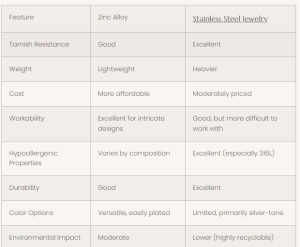
Note: The data in the table above illustrates the comparative differences between the two materials.
While stainless steel provides superior rust resistance and baseline durability, zinc alloy holds distinct advantages in design flexibility, weight, and production costs. Many manufacturers strategically utilize both materials depending on a collection’s design demands and pricing strategy. As a leading zinc alloy manufacturer, we advise brand managers to heavily leverage zinc alloy for design-forward, fast-fashion lines, while utilizing stainless steel for minimalist, evergreen staple pieces.
V. Critical Quality Factors in Zinc Alloy Jewelry Manufacturing
Many purchasing managers focus solely on unit price when vetting a zinc alloy manufacturer, inadvertently ignoring the critical technical factors that dictate the product’s actual lifespan:
- ISO 9227 Salt Spray Testing: Always ask your supplier if they can provide a verifiable 48-hour test report.
- PVD and Nano-electrophoresis: These are not just marketing buzzwords; they are core technologies proven to reduce the speed of tarnishing by 40%.
Precise Alloy Composition:
- Higher zinc content generally improves overall corrosion resistance.
- Adding copper enhances structural strength, though it may slightly reduce tarnish resistance.
- Aluminum and magnesium can simultaneously improve both tensile strength and corrosion resistance.
- Specific trace elements can be added to achieve highly customized performance metrics.
VI.Custom Zinc Alloy Jewelry Solutions for Brands
For brands seeking customized jewelry, zinc alloy offers an outstanding balance of design flexibility, durability, and cost efficiency. By partnering with a professional jewelry manufacturer, brands can fully leverage the material’s strengths while systematically minimizing potential tarnishing issues.
Our custom zinc alloy solutions include:
- Alloy Customization: We adjust specific alloy compositions to meet the exact demands of your design or application.
- Professional Surface Treatments: We offer a vast array of finishes, from high-gloss polishing to specialized vintage effects, to elevate both aesthetics and durability.
- Hybrid Processing: We can seamlessly integrate zinc alloy components with other materials, such as stainless steel, for parts requiring exceptional structural durability.
- Advanced Coatings: We utilize state-of-the-art protective technologies to maximize anti-tarnish capabilities.
- Design Optimization: We help engineer your designs to minimize high-friction or tarnish-prone areas while maximizing the visual impact.
By collaborating with an experienced manufacturer, your brand can build a zinc alloy jewelry collection that retains its beauty with minimal maintenance requirements.
Ready to leverage custom zinc alloy jewelry? As a leading high-end jewelry manufacturer in China, TOP Jewellery holds a distinct competitive advantage in custom zinc alloy production. We specialize in end-to-end bespoke solutions, taking your vision from initial concept to finished product. Our technical expertise ensures your designs are both stunning and built to last.
We proudly provide:
- Professional guidance on material selection.
- Customized alloy formulas tailored to your specific requirements.
- Advanced surface treatments and coating technologies.
- Comprehensive, rigorous quality control.
- Full-process solutions from design engineering to mass production.
If you are a jewelry brand looking to create a durable, custom zinc alloy collection, please contact us today to discuss your project. Our team of experts is ready to help you realize your vision through the right materials and precise manufacturing processes.
Contact us:https://www.top-jewelry.net/contact-us
VII.FAQ: Real-World Answers for Purchasing Managers
Q: Does zinc alloy jewelry turn the wearer’s skin green?
A: As a strictly compliant zinc alloy manufacturer, we utilize completely nickel-free and lead-free formulas, ensuring that the jewelry does not turn the wearer’s skin green. Skin discoloration is typically caused by low-end factories mixing excessive amounts of untreated copper into their alloys.
Q: Why does my product inventory sometimes tarnish while still in storage?
A: Tarnishing in storage is usually caused by salt spray erosion during ocean freight transportation. To prevent this, Top Jewelry provides industrial-grade vacuum moisture-proof packaging for every bulk shipment, ensuring zero quality degradation from the time it leaves our factory until it reaches your warehouse.
Q: What are your factory’s manufacturing qualifications?
A: Our facilities regularly pass rigorous Sedex 4-Pillar and Disney FAMA audits. This demonstrates that as your zinc alloy manufacturer, we not only master the technical craftsmanship but also fully understand and meet your strict global compliance requirements.
https://www.top-jewelry.net/what-is-sedex-certification/
https://www.top-jewelry.net/what-is-the-fama-audit-for-disney/
Q: How do you prove the safety and compliance of your materials for our global distribution needs?
A: We provide complete Declarations of Conformity (DoC) for REACH and RoHS to guarantee compliance with the extremely strict legal limits on lead, nickel, and cadmium release in European and American markets. Furthermore, because we are a Disney FAMA and Sedex 4-Pillar certified zinc alloy manufacturer subject to regular on-site audits, our raw materials are fully traceable, which guarantees zero compliance risks for your brand during customs inspections or market surveillance.
https://echa.europa.eu/candidate-list-table
Q: How do you ensure consistent anti-tarnish performance during mass production?
A: Top Promotion utilizes a specialized “bath monitoring system” where we conduct spectral analysis on the electroplating vats every four hours to ensure gold salt concentrations and pH levels remain in the optimal range. Additionally, we consistently send random samples from mass production to third-party laboratories for re-testing, which ensures every batch has equal oxidation resistance and eliminates any discrepancies between pre-production samples and final bulk orders.
Q: What is the Minimum Order Quantity (MOQ) for custom zinc alloy jewelry?
A: The minimum order quantity for custom zinc alloy jewelry manufactured by TOP Jewelry is 1,000 pieces.
Editor:Felix